

The four components of TDEE
TDEE is calculated as the sum of four physiological components. Each component represents a unique part of the body's energy expenditure without overlap:
TDEE = BMR + NEAT + EAT + TEF
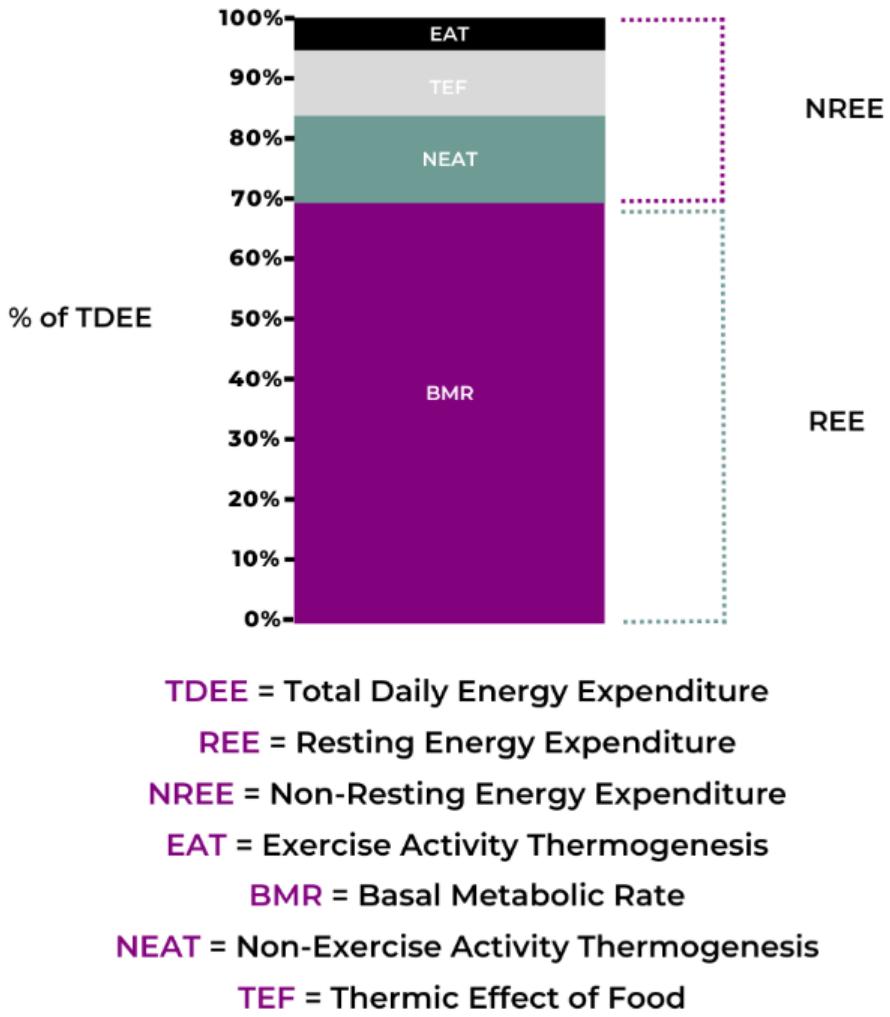
BMR — Basal Metabolic Rate (approx. 60–75% of TDEE)
BMR (Basal Metabolic Rate) is the energy the body requires to maintain basic physiological functions at complete rest — breathing, blood circulation, temperature regulation and cellular processes. The most important determinant of BMR is fat-free mass, which is estimated to explain around 80% of the variation.
In people with low physical activity, BMR typically constitutes about 60% of total energy expenditure, and even more in individuals with very low movement activity such as sedated and mechanically ventilated patients in intensive care units.
BMR is measured under strictly controlled laboratory conditions: after sleep, in a fasting state and in a thermoneutral environment. In practical contexts, RMR (Resting Metabolic Rate) is more commonly used, measured at any time during the day, which can differ from BMR by up to 10%. Most online calculators — including Calculeat — technically calculate RMR, but use the term BMR in everyday use.
The gold standard for measurement is indirect calorimetry via Weir's equation (1949). When unavailable, predictive equations such as Mifflin-St Jeor, Harris-Benedict or Cunningham are used, which have a margin of error of ±10–15% at the individual level.
NEAT — Non-Exercise Activity Thermogenesis (15–30%)
NEAT encompasses all energy expenditure from bodily movements that are not planned exercise: walking, standing, household chores, fidgeting and postural adjustments. It is the most variable component — and the most underestimated.
In normally active individuals, NEAT constitutes approximately 15–30% of TDEE, but the variation is extreme. In very inactive individuals, NEAT can be as low as 6–10%, while in active individuals it can exceed 50% of total energy expenditure. In a controlled overfeeding study, the change in NEAT ranged from −98 to +692 kcal/day between individuals with similar body composition (Levine et al., 1999). Total differences in NEAT between individuals can amount to over 1,000 kcal/day.
It explains why two people of identical weight and training routine can have such different calorie needs — the difference lies in spontaneous movement outside the gym, not in the training sessions.
EAT — Exercise Activity Thermogenesis (5–10%)
EAT represents energy expenditure from planned physical exercise. It typically constitutes a surprisingly small proportion of TDEE — under 5% in sedentary individuals. At high training volumes, EAT can increase to 15–30% or more in elite athletes (Westerterp, 2013).
TEF — Thermic Effect of Food (8–15%)
TEF is the energy required for digestion, absorption and metabolism of nutrients. Under energy balance, TEF averages about 10% of energy intake, with a typical range of 8–15% depending on meal composition.
TEF varies markedly between macronutrients:
- Protein: approx. 20–30% amino acid metabolism and urea formation are energy-intensive
- Carbohydrates: approx. 5–10% Carbohydrates: approx. 5–10%
- Fat: approx. 0–3% low thermogenic effect
The practical consequence: a protein-rich diet genuinely produces slightly higher energy expenditure at the same calorie intake compared to a fat-dominated diet (Westerterp, 2004; Halton & Hu, 2004).
How is TDEE calculated?
The simplest method is BMR × PAL factor:
- Calculate BMR with Mifflin-St Jeor (recommended for healthy adults)
- Multiply by a PAL factor (Physical Activity Level) that reflects your activity level
Example: BMR 1,800 kcal × PAL 1.55 (moderately active) = 2,790 kcal TDEE.
How do you use TDEE in practice?
TDEE is your maintenance need. Depending on goal:
- Weight loss: Eat 300–500 kcal below TDEE → approx. 0.3–0.5 kg/week
- Muscle building: Eat 200–400 kcal above TDEE → lean bulk with minimal fat gain
- Maintenance: Eat at TDEE → stable weight
The calculator provides an estimate. The margin of error is at least ±10–15% from the BMR formula, with the uncertainty in the activity factor on top of that. Monitor your weight for 2–3 weeks and adjust if the result doesn't match expectations.
Why does TDEE drop during a diet?
Adaptive thermogenesis — the body lowers its metabolism in response to prolonged calorie deficit. It happens at several levels: NEAT decreases (the body instinctively moves less), BMR drops slightly and digestive efficiency increases. NEAT is the component that reacts fastest and most — and it is also why weight loss slows down despite unchanged intake.
Solution: take regular "diet breaks" (shorter periods at maintenance intake) to counteract the adaptation, and prioritise strength training to preserve muscle mass and keep BMR up.